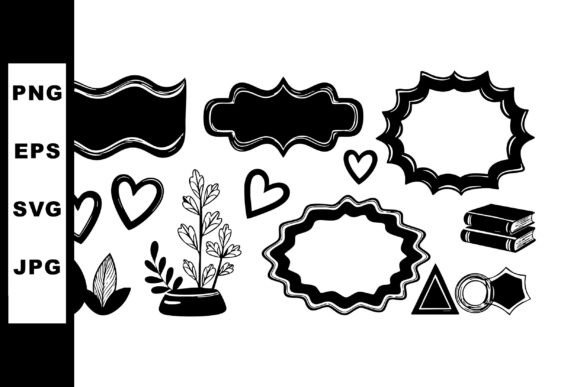
Decorative Vintage Frames Hearts Leaves Graphics
As a blog designer who’s built over 200 editorial websites and managed visual content for digital publishers across lifestyle, education, and affiliate niches, I opened Decorative Vintage Frames Hearts Leaves expecting charm—and got a quietly powerful graphic design asset. What arrives in the ZIP isn’t just decoration; it’s a cohesive set of black-and-white vector illustrations featuring ornate frames interwoven with hearts, botanical leaves, open books, and subtle geometric motifs. The classic mood is immediate: elegant but approachable, nostalgic without feeling dated, detailed without overwhelming. It leans gently feminine and literary—ideal for bloggers covering mindful living, vintage aesthetics, bookish content, herbal wellness, journaling, or slow-living education—but its clean line work and balanced negative space keep it versatile enough for creative entrepreneurs and online educators building digital guides or printable design resources.
Why This Set Fits Real Editorial Workflows—Not Just Stock Libraries
I tested Decorative Vintage Frames Hearts Leaves across six live publishing scenarios: blog featured images, Pinterest pins for a seasonal digital guide, newsletter headers, category thumbnails on a recipe-education site, Canva templates for client lead magnets, and eBook cover mockups. In every case, it elevated perceived quality—not by shouting, but by grounding the layout in intentional editorial design. Unlike generic clipart or overused floral PNGs, these frames create instant visual hierarchy. When placed behind a headline or framing a quote, they signal care, craftsmanship, and curation. Readers subconsciously associate that intentionality with trustworthiness—especially critical for affiliate marketing pages or downloadable resources where credibility drives conversions.
Where It Delivers Strongest Visual Impact
- Blog featured images: Paired with serif headlines and soft background textures, the frames add gravitas to evergreen posts—think “10 Journaling Prompts for Emotional Clarity” or “A Beginner’s Guide to Herbal Teas.”
- Pinterest pins: The high-contrast black-and-white vector scales beautifully at vertical ratios (2:3, 4:5). SVG and PNG files retain crispness even when cropped tightly around text overlays.
- Digital guides & lead magnets: Used as section dividers or chapter headers inside PDFs and Notion templates, the frames reinforce brand identity without competing with content.
- Newsletter headers: A single centered frame—scaled to 300px wide—with a short tagline (“This Week’s Creative Spark”) builds consistency across email campaigns.
- Category visuals & website header accents: Applied subtly as corner flourishes or border elements, they unify navigation without sacrificing modern web design principles.
Where to Use Decorative Vintage Frames Hearts Leaves Thoughtfully
This isn’t a universal drop-in solution—and that’s part of its strength. Its decorative nature means it should be used deliberately. Avoid placing it directly behind dense paragraph text or in mobile-first thumbnails under 120px wide, where detail blurs into noise. Steer clear in serious professional niches like fintech, legal SaaS, or enterprise B2B—unless you’re designing a lighthearted internal resource or team newsletter. It also risks visual fatigue in busy layouts with multiple fonts, icons, and photo overlays. If your site relies on extreme minimalism or monochrome sans-serif rigor (think tech documentation or developer blogs), this set may clash with your existing design language.
Practical Publisher Notes You’ll Actually Use
- Test contrast: Overlay headline text in both light and dark modes—some PNGs render slightly softer than SVGs on retina screens.
- Preview in context: Drop the SVG into your actual blog theme editor—not just a blank canvas—to see how spacing, padding, and font pairings respond.
- Font pairing matters: It sings beside serif fonts (Playfair Display, Cormorant Garamond) and gentle scripts (Dancing Script, Amatic SC), but can feel fussy next to aggressive display fonts or ultra-thin sans-serifs.
- Optimize for speed: Use SVG for inline web use (headers, icons); compress JPG/PNG versions with TinyPNG before uploading to CMS—file sizes in the ZIP are production-ready but benefit from further web-specific compression.
- Verify licensing: The commercial license covers monetized blogs, affiliate marketing pages, and paid digital products—but double-check terms if bundling into Canva templates for resale.
How It Strengthens Content Marketing Beyond Aesthetics
What makes Decorative Vintage Frames Hearts Leaves more than pretty packaging is how it supports long-term content strategy. Consistent use across Pinterest pins, blog graphics, and downloadable printables creates recognizable visual shorthand—readers begin to associate those delicate hearts and leaf motifs with your voice and values. That builds brand identity faster than color palettes alone. For small business branding, it adds artisanal warmth to otherwise functional assets: a worksheet becomes a keepsake, a media kit feels curated, a social media graphic stands out in algorithmic feeds not because it’s loud, but because it’s *cohesive*. In affiliate marketing, that cohesion translates to higher click-through potential—the frame signals “this recommendation was chosen with care,” not scraped from trend reports.
A Final Word for Creative Designers & Digital Publishers
If you’ve ever spent hours tweaking free vectors only to find them pixelated, mismatched, or legally ambiguous—you’ll appreciate how cleanly Decorative Vintage Frames Hearts Leaves integrates into real-world publishing. It’s not flashy. It doesn’t chase trends. But as an editorial tool, it delivers reliability, versatility, and quiet sophistication. Whether you're launching a digital download store, redesigning a content-heavy website, or building a visual library for client work, this set earns its place—not as filler, but as foundational design assets. In a landscape saturated with generic graphics, it’s a reminder that thoughtful illustration still shapes how readers see, trust, and return to your content.